Arts and Education / Tell it to the young
Actors channel Anne Frank and MLK to inspire youth through paired monologues

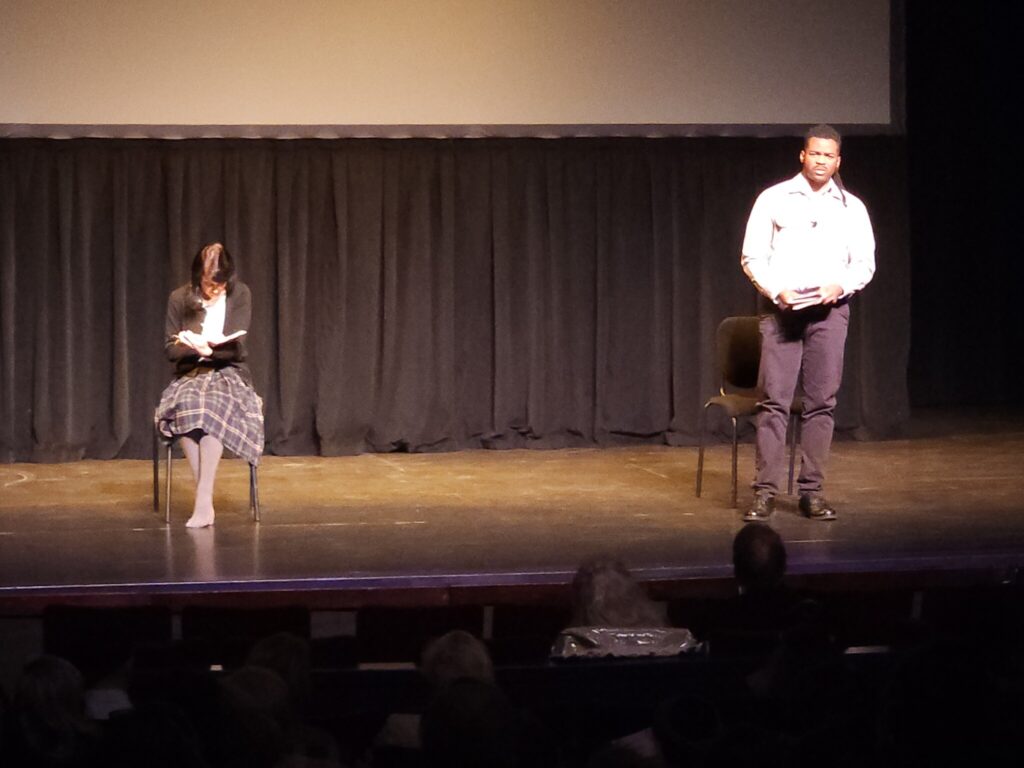
Amelia Dudley and Marcel Daly portray Anne Frank and Martin Luther King Jr. (Photo by Adam Reinherz)
Actors portraying Anne Frank and Martin Luther King Jr. treated an audience to competing monologues about persecution, faith and hope.
Each holding a journal and writing utensil in hand, Amelia Dudley, playing Frank, and Marcel Daly, playing King, expressed bewilderment and awe at fellow humans’ responses to legally imposed harms. As the actors sat, stood and paced across the nearly empty stage on Nov. 14 at the August Wilson African American Cultural Center, they encouraged attendees to envision how “The Diary of a Young Girl” and “Letter from Birmingham Jail” came to be.
Hours earlier, the acting duo delivered a similar performance at Pittsburgh Allderdice High School.
Speaking to theatergoers following the performance at the August Wilson Center, Dudley and Daly said it’s inspiring to portray iconic 20th-century figures, but there’s a particular significance in doing so for students.
Dudley credited Allderdice students and educators with using the 40-minute performance as a springboard to ask difficult questions about building a “broader community.”
“I had a little bit of tears in my eyes,” Daly said. “We were in their shoes, and then we’re going to blink, and they’re going to be in our shoes. They are going to be making these decisions.”

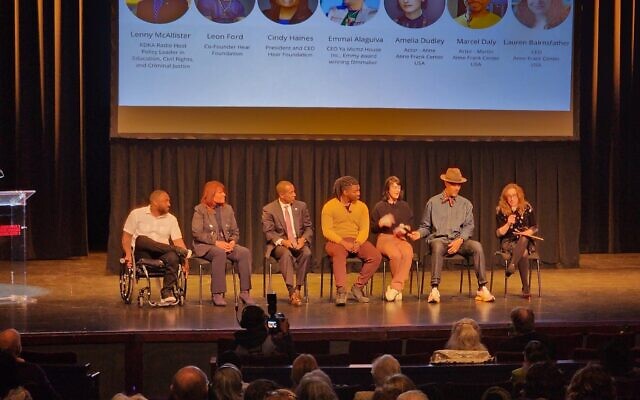
Panelists join a “Voices for Change program” at August Wilson African American Cultural Center on Nov. 14. (Photo by Adam Reinherz)
The Thursday night talkback, which was joined by community activists, was part of the Anne Frank Center USA and Hear Foundation’s “Voices for Change” program. Moderated by Anne Frank Center CEO Lauren Bairnsfather, the discussion welcomed Dudley, Daly, Emmy Award-winning artist Emmai Alaquiva, journalist and political commentator Lenny McAllister, Hear Foundation President and CEO Cynthia Haines, and Hear Foundation co-founder and Director of External Affairs Leon Ford.
Though the event was largely attended by adults, panelists dedicated most comments to the young.
Students may know the “I Have a Dream” speech, but it’s less likely they’re familiar with “Letter from Birmingham Jail,” Daly said. The performance and subsequent discussion enabled students to “explore critical thinking” and imagine King’s considerations.
The beauty of this show, and similar endeavors, is the mirror-like quality of art that allows young people to “look at themselves,” Alaquiva said. That gaze prompts action, he continued. “I just want us to realize that young people are essentially who we need to pass the baton to.”
Empowering youth requires an understanding of them, panelists said.
Works can be “meaningful as literary pieces,” but teachers have to remember students won’t always see the connections, McAllister said. “If you don’t have curriculums that allow you to connect to it, you can’t get the lesson out of it — and not just the lesson of how do you conjugate a verb, but also what’s the lesson I’m supposed to be thinking about at four o’clock in the afternoon, when I’m at the mall, when I’m meeting a stranger, when I’m in a new culture?”
Performances and discussions that take texts to new places are essential educational tools, Ford said. “During these times of uncertainty — when TV and social media tell us how disconnected and divisive we are — this is the example of our truth,” he said. “Our truth is we’re not disconnected, we’re very much connected, and the more we show up for one another, the more we can feel that truth and its reality.”
Both Frank and King were born in 1929. Seeing them brought to the stage and hearing about additional efforts to impact today’s youth was inspiring, Squirrel Hill resident Avi Baran Munro said.
Fellow Squirrel Hill resident Tom Engel agreed, and commended the Anne Frank Center and Hear Foundation for disseminating Frank and King’s teachings to students.
“Youth is our hope and we need them,” he said.
Greenfield resident Audrey Glickman exited the August Wilson Center Thursday night voicing similar praise.
Glickman, a survivor of the Pittsburgh synagogue shooting, who often speaks alongside survivors and family members of those lost in the 2018 attack, said the panelists’ message is “almost exactly the same thing” she tries to convey every time she speaks.
“It’s on the youth,” she said. “The youth have to understand.” PJC
Adam Reinherz can be reached at areinherz@pittsburghjewishchronicle.org.